Private-well treatment planning
Design around the individual well, household demand and a retesting plan.
 BySimple Water Service
Jupiter Farms, Florida · by Simple Water Service
Explore well testing, iron and odor assessment, filtration and existing-system service in Jupiter Farms, by Simple Water Service.
Start by confirming which source feeds the household plumbing. A well used for landscaping does not necessarily supply the kitchen and showers. In Jupiter Farms, the relevant well-water service conversation should identify the potable source, the actual test findings and the treatment already installed. Do not assume that neighboring properties share identical iron, odor, hardness or flow conditions.
The Florida Department of Health in Palm Beach County maintains private-well guidance and local laboratory information. Its September 25, 2025 laboratory notice describes bacterial testing services and recommends regular well testing. These are local resources for planning sampling; they are not a published water-quality result for every Jupiter Farms property. The official well program also distinguishes irrigation and drinking-water wells.
Simple Water Service’s Jupiter page expressly includes Jupiter Farms, and its published services cover well-water treatment and existing-system work. The provider’s phone and native request form are available here. Ask it to confirm the address, equipment support and the scope of an assessment. This site makes no claim about a local installed job, staff credential or laboratory result at your home.
For a Jupiter Farms household well, use property-specific sampling. Palm Beach County well-program guidance does not supply a universal chemistry result, and a Jupiter municipal report cannot characterize a private well. See the Jupiter Farms source guide before applying a report or selecting a treatment goal.
A decision sequence, not a prescribed installation
Design around the individual well, household demand and a retesting plan.
Identify the measured cause of staining before selecting a treatment train.
Map where the odor appears before choosing oxidation or filtration.
Choose a sampling plan that answers the actual property question.
Understand what each installed tank does before changing the sequence.
Use the actual model and treatment goal to set the service schedule.
A well-water treatment plan begins with the individual source. Keep the laboratory collection date, sample location, concentrations and units together. Describe any recent odor, staining, sediment, repairs or changes near the well. A sales screen can help with a hardness or equipment question, but it does not replace an appropriate certified laboratory panel for a specific health-related concern. Ask the laboratory which tests and sampling instructions fit the actual situation.
Use the county health resources linked in the source guide to find the right conversation about sampling. The local well program and laboratory notice answer different questions: one concerns well construction and source identification, while the other offers information about bacterial testing services. Neither assigns a single hardness, iron or sulfur reading to every property. Confirm current services and pricing directly before collecting a sample.
An irrigation well can explain stains around sprinklers without characterizing the kitchen water. Ask a qualified provider to identify the water entering the house, its isolation points and any separate landscape line. Keep the utility bill, well records and actual pipe route in the same discussion. Do not decide the treatment location simply from the presence of a pump or well on the property.
The distinction changes scope. Equipment on the household entry does not automatically treat a separate irrigation source, and an irrigation sample cannot be treated as a result from the drinking-water tap. A quote should name the line being treated and explain any separation. Safe plumbing and source protection need professional review; do not casually join sources or reroute a bypass.
Photographs can show where staining occurs and whether it changes after existing equipment, but they do not establish the constituent or concentration. Ask which measurements distinguish iron, manganese, corrosion or another cause. Keep pH, available flow and the relevant findings with the treatment proposal so the media selection can be assessed against actual operating conditions.
For a proposed iron stage, ask whether oxidation or contact time is needed, what downstream component performs removal and how the media will be cleaned. A softener should not be assumed to address every iron condition. The written plan should state its target, operating range, backwash needs and the agreed verification after installation or service.
Record whether the odor appears at one faucet or throughout the home, at hot taps or cold taps and before or after treatment. A hot-water-only concern can require a different investigation from a smell at every cold-water fixture. Odor is a useful observation but is not a complete diagnosis or a water-safety result.
Bring that pattern to the provider or laboratory. If oxidation, aeration or filtration is proposed, ask which identified condition it addresses and how flow, contact requirements, consumables and maintenance affect the design. A carbon tank should not be promised as a universal odor solution. The next useful step is the appropriate investigation rather than a tank selected from a general neighborhood claim.
A conventional softener has a distinct hardness-removal role. Measure actual incoming hardness and compare it with treated hardness when checking an existing unit. Record the resin volume, capacity, salt setting and regeneration history if known. If scale returns, an obstructed brine path, settings issue or valve problem can need different work from resin replacement.
Keep other measured constituents in the sizing discussion when the equipment instructions require it. Do not use a TDS reading as an isolated hardness measurement, and do not assume softening resolves a separate laboratory finding. Ask each proposed stage to earn its place by having a stated and verifiable purpose.
The well, pump and pressure tank constrain what equipment can do. A tank's backwash requirement is separate from its service-flow rating. Ask the provider to compare the manufacturer's required cleaning flow with measured supply capability and the intended drain route. A media bed that cannot be cleaned as designed can lose performance even when the household has enough water for ordinary use.
Document simultaneous fixture demand, available pressure and relevant well-yield information. Review pressure drop through the proposed sequence and the operating conditions for each stage. Changing valve settings beyond approved instructions is not a substitute for a suitable design. If the source cannot support the equipment, compare another arrangement before committing to installation.
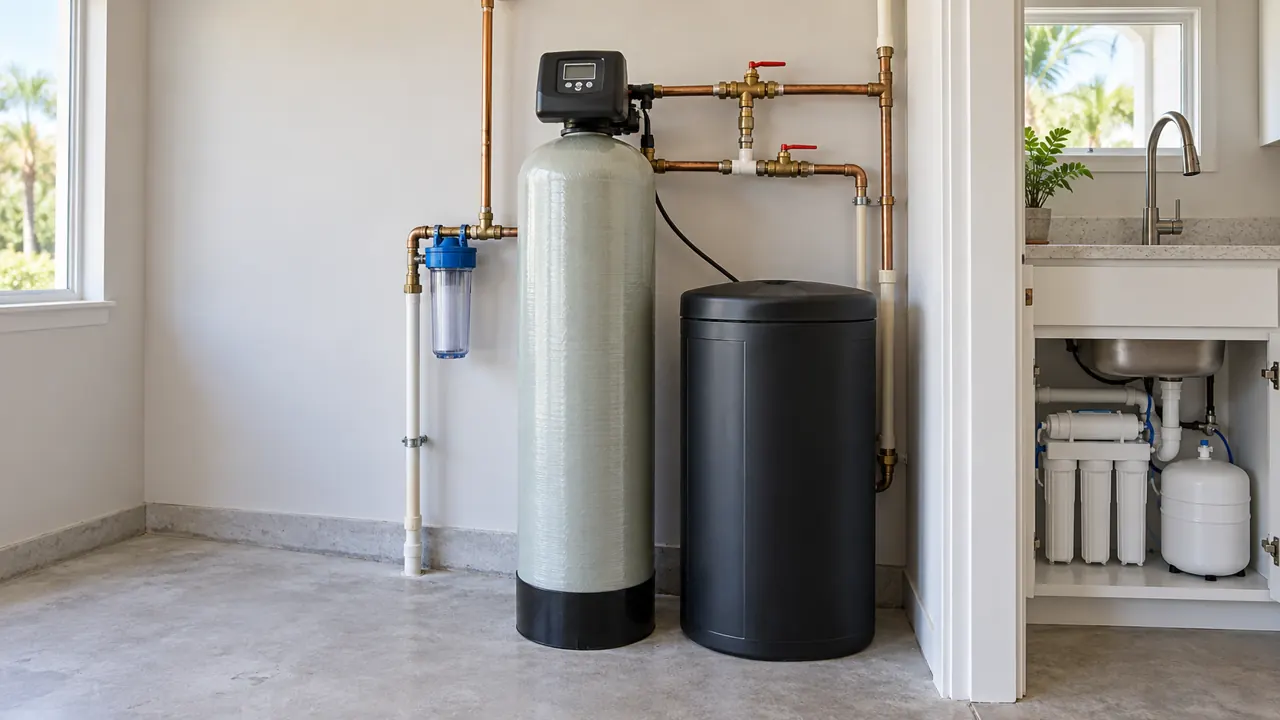
Similar vessels can contain different media. Photograph the labels and have the provider trace the actual sequence, bypasses, sample ports and drains. Keep the original treatment goals, last-service dates and replacement parts with the current water results. An unlabeled tank should not be presumed to be carbon, resin or an iron filter.
Compare a failed component, overdue media service and an unsuitable capacity as separate questions. Repairing one stage can be worthwhile if it restores a suitable system; adding another stage can be unnecessary if the original problem was an obstruction or missed maintenance. Ask for written findings and priorities rather than discarding working equipment to match a larger package.
For a filter or disinfection stage, request the complete model, supported purpose and required incoming-water conditions. A certification symbol without a listed claim does not establish reduction of every substance. A component claim is also not automatically proof for the complete installation. The exact target and maintenance conditions need to match the actual findings.
Where UV is proposed, discuss required pretreatment, flow, power continuity, lamp and sleeve care and alarm behavior. A glowing lamp and clear-looking water are not one universal proof of suitability. For a health-related well finding, use laboratory and public-health interpretation and a verification plan before assuming installed equipment has resolved the concern.
An under-sink reverse-osmosis system serves a drinking or cooking-water objective and does not treat showers or every appliance. Compare its model-specific claims with the source findings, expected pressure and temperature, actual output, storage and faucet or refrigerator routing. More stages are not automatically better performance or lower upkeep.
For existing RO, include the filter and membrane dates, storage behavior and whether the problem concerns taste, flow or a leak. The tank, feed pressure, cartridge and membrane can require different checks. Ask the service scope to identify the cause, exact parts, sanitizing or flushing requirements and the result expected afterward.
A well-treatment quote can include sampling, several purposeful stages, plumbing, electrical or drain work and startup verification. Ask which items are fixed and which depend on inspection or additional results. Removal, disposal, isolation, bypasses and sample ports should be visible in the scope. Weather protection and maintenance access matter after the system is installed.
Compare consumables, salt, media care, service visits and laboratory retesting with the upfront price. A neighbor's total can omit a condition that matters at this property. Keep covered parts, labor and exclusions in writing and do not treat a general lifetime promise as a complete maintenance plan.
Choose the relevant endpoint before authorizing service. Hardness is relevant to softening; flow and pressure drop are relevant to a restriction; and an identified well constituent may require appropriate sampling. Use comparable sample points and conditions and follow startup instructions. A new equipment photograph or a visit record does not independently establish that every treatment goal has been met.
Retain the final settings, model and part numbers, dated results and future service triggers. If the agreed outcome is missing, ask for an investigation of the cause before adding hardware. If the well changes after flooding or repair, review official well-owner guidance and qualified inspection rather than assuming the previous treatment still fits.
Share the property city and ZIP, whether the household has a potable well, where the concern appears and the current equipment. Bring model numbers and dated results without submitting sensitive health records through the contact form. Simple Water Service confirms address coverage, equipment support, availability and the assessment or service scope directly.
Use the well-testing guide, compare iron assessment and odor investigation, or start with the existing-equipment inventory. The educational check helps select a conversation; it does not diagnose water safety or reserve a service time.
by Simple Water Service
Share the source, main concern and existing equipment. The provider confirms coverage, availability and the written scope for the actual property.
Call (561) 309-6270A request asks for contact; it does not reserve an appointment.
If the form does not load, open the quote form.